
WATER HEATER TROUBLESHOOTING
Why Do I Have No Hot Water?
No hot water can have very different causes depending on whether your home uses a gas water heater, electric tank, tankless system or boiler/combi system. Start with what you’re experiencing and narrow down the likely problem.
Important:
If you smell gas, see active leaking around electrical components,
or believe there may be a combustion or venting problem, stop
troubleshooting and get professional help.
START HERE
First, Work Out What “No Hot Water” Actually Means
A completely cold shower and a shower that turns cold after ten minutes are not necessarily the same problem. Before looking at the water heater itself, check whether the problem affects the whole home and exactly how the hot water is behaving.
That distinction can quickly separate a water-heater problem from a fixture problem, capacity issue or another part of the home’s plumbing or mechanical system.
01
No hot water anywhere
If every hot-water fixture runs cold, start with the water-heating system itself — including its power, fuel supply, controls and ability to produce heat.
02
Only one fixture is affected
If other taps still produce normal hot water, the problem may be local to that faucet, shower valve or fixture rather than the water heater.
03
Water is warm, but not hot
Lukewarm water can point toward temperature settings, heating components, mixing issues, demand or a system that is not operating correctly.
Water not hot enough? →
04
Hot water runs out quickly
A tank may still be heating but not providing its expected usable capacity. Demand, recovery, sediment or internal component problems may need to be investigated.
STEP 1
What Type of Water Heater Do You Have?
The next troubleshooting step depends heavily on the equipment producing your hot water. A gas tank, electric tank and tankless unit do not fail in the same way.
GAS
Gas Tank Water Heater
Usually a cylindrical storage tank with a gas supply, burner assembly and exhaust vent or flue. Loss of hot water can involve ignition, gas supply, burner controls or other components.
Troubleshoot gas →
ELECTRIC
Electric Tank Water Heater
A storage tank powered electrically rather than by a gas burner. Electrical supply, controls and heating elements are among the areas that may be involved when the tank stops heating.
Troubleshoot electric →
ON DEMAND
Tankless Water Heater
Tankless equipment heats water as it is requested. No-hot-water problems may involve power, gas, ignition, flow requirements, controls or a system fault.
Troubleshoot tankless →
HYDRONIC
Boiler or Combi System
Some homes produce domestic hot water through a boiler, combi boiler or related hydronic equipment. A loss of hot water can therefore involve more than a conventional water heater.
Troubleshoot boiler/combi →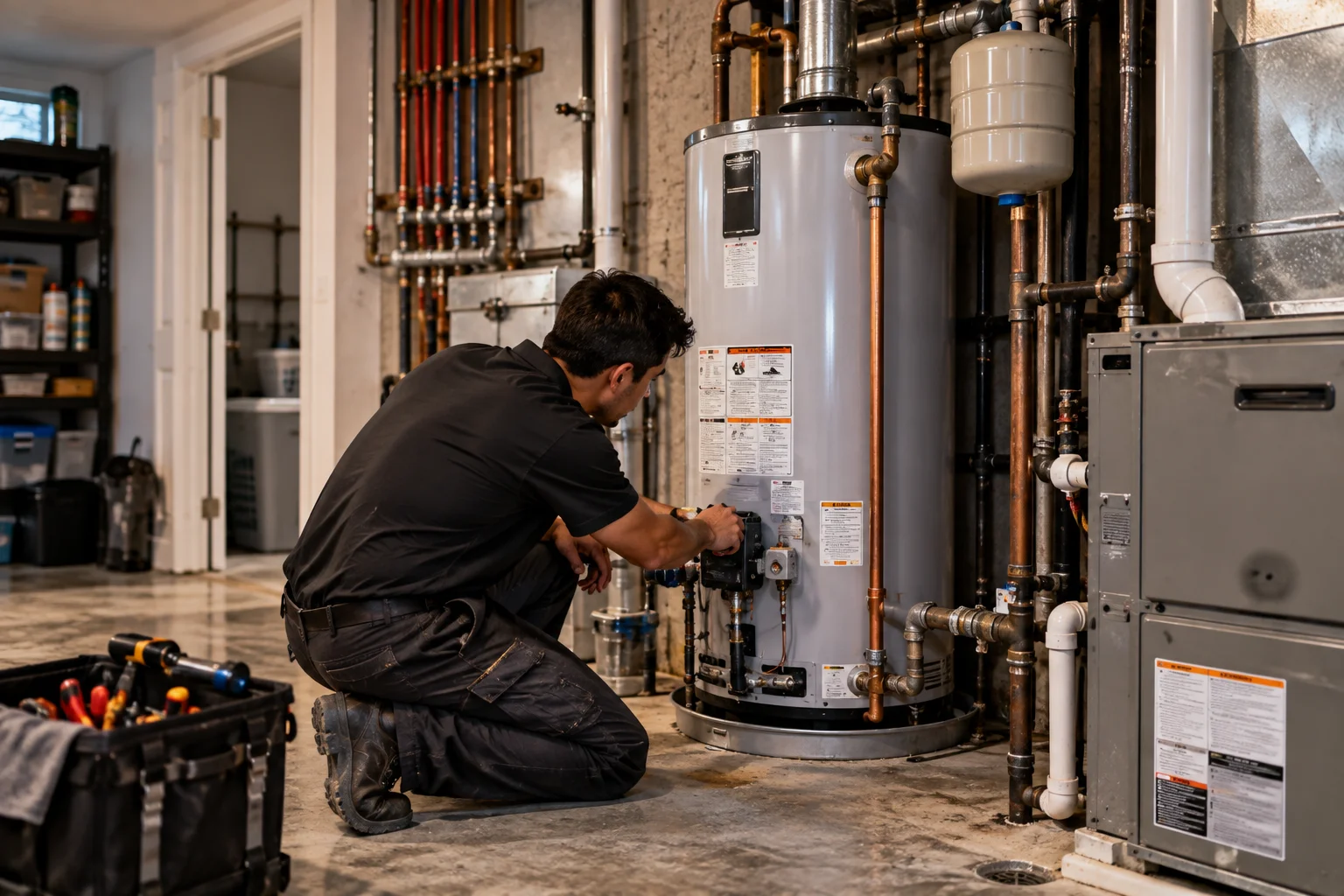
DIAGNOSIS MATTERS
Don’t Replace Parts Until You Know What Actually Failed
“No hot water” describes the symptom, not the cause. The same complaint can come from a loss of power, interrupted gas supply, ignition problem, failed heating component, control fault, flow issue or another condition entirely.
That is why identifying the equipment and observing what it is doing is more useful than immediately assuming the entire water heater needs replacement.
Identify
the type of water-heating equipment
Observe
whether the failure is complete or intermittent
Check
only safe homeowner-accessible items
Diagnose
the actual fault before deciding repair or replacement
01
GAS TANK WATER HEATER
No Hot Water From a Gas Water Heater
A gas storage water heater needs both a usable gas supply and a functioning ignition/burner system to heat the tank. If either side of that process is interrupted, the tank can remain full of water while producing no usable hot water.
Possible areas to investigate
- The unit may not be receiving gas.
- The pilot or ignition system may not be operating correctly.
- The burner may not be firing when heat is required.
- A control or safety component may have interrupted operation.
- The water heater may have shut down because of an equipment fault.
What you can safely observe
Check whether the water heater appears to have power where applicable, whether its controls show an obvious status or fault, and whether other gas appliances appear to be operating normally. Follow the manufacturer’s operating instructions for your specific unit rather than bypassing a safety control.
Stop if you smell gas.
Do not attempt to relight, disassemble or continue diagnosing equipment if you smell gas or suspect a gas leak. Leave the affected area and follow the appropriate gas-emergency procedure.
02
ELECTRIC WATER HEATER
No Hot Water From an Electric Tank
Electric storage tanks use electrical heating components to bring the stored water up to temperature. A complete loss of hot water can therefore begin with the electrical supply or with components inside the heater.
Possible causes include
- Loss of electrical power to the water heater.
- A tripped breaker or another electrical supply problem.
- A thermostat or control problem.
- A failed heating element or related internal component.
- A safety device that has interrupted heating.
A reasonable first check
You can check the home’s electrical panel to see whether the labelled water-heater breaker is obviously tripped. If it has tripped repeatedly, or immediately trips again, do not keep resetting it. The underlying electrical or equipment fault should be diagnosed.
Do not open electrical compartments unless qualified.
Water heaters can contain high-voltage electrical components. Removing covers and testing internal wiring is different from checking a breaker and should be left to an appropriately qualified professional.
03
TANKLESS WATER HEATER
Tankless Water Heater Running, But No Hot Water?
A tankless system responds to water flow rather than maintaining a large tank of hot water. That changes the diagnostic process. The unit must recognize sufficient demand and successfully complete its operating sequence before it can deliver hot water.
Look for clues such as
- An error or fault code on the unit’s display.
- The unit not responding when a hot tap is opened.
- Hot water starting and then suddenly turning cold.
- Problems occurring only at low-flow fixtures.
- The system repeatedly attempting to start but failing.
The exact meaning of an error code depends on the manufacturer and model. Record the code before resetting the equipment so that it can be referenced against the correct documentation.
Explore Tankless Error Codes →
04
BOILER / COMBI SYSTEM
What If Your Boiler Also Produces Your Hot Water?
In some homes, domestic hot water is connected to a boiler or combi system rather than a stand-alone tank. In that case, the relationship between space heating and hot water can provide useful diagnostic clues.
Heating works, hot water doesn’t
The boiler may still be capable of producing heat while a component or control associated with domestic hot water is not operating correctly.
Neither heating nor hot water works
A broader boiler, fuel, power or control problem may need investigation rather than treating the issue as an isolated hot-water failure.
Boiler and combi systems can vary significantly by installation. If you are unsure how your domestic hot water is produced, identifying the equipment before troubleshooting can prevent you from chasing the wrong problem.
Explore Boiler Services →
CHECK THE AREA
Is There Water Around the Water Heater?
A loss of hot water combined with visible water around the tank, nearby piping or equipment changes the situation. The moisture could come from a connection, valve, discharge, condensation or the tank itself, and the source matters.
Do not assume a puddle automatically means the tank has failed, but don’t ignore active leaking either. Water can damage surrounding materials and can create additional concerns when it reaches electrical equipment.
Water Heater Leaking?
WHAT HAPPENS NEXT?
No Hot Water Doesn’t Automatically Mean You Need a New Water Heater
The appropriate solution depends on what failed, the condition of the equipment and whether repairing the existing system makes sense.
REPAIR
The system may be repairable
If the problem is associated with a serviceable component, control, ignition system or other repairable fault, restoring the existing unit may be the appropriate approach.
Water Heater Repair →
REPLACEMENT
Replacement may enter the conversation
Equipment condition, repeated failures, tank deterioration, repair practicality and the overall state of the system can affect whether replacement should be considered.
Water Heater Replacement →
PREVENTION
Maintenance can reveal developing problems
Routine inspection and maintenance can help identify visible deterioration, operational problems and other issues before they become a complete loss of hot water.
Water Heater Maintenance →
QUICK DECISION PATH
Still Trying to Work Out What’s Wrong?
1
Check another hot-water fixture
Determine whether the problem affects one fixture or the whole home.
2
Identify your water-heating system
Gas tank, electric tank, tankless and boiler systems require different diagnosis.
3
Look for obvious status information
Check displays, visible fault codes and safe-to-observe power or operating indicators.
4
Look for leaking or unusual conditions
Water, gas odours, repeated shutdowns or electrical problems require additional caution.
5
Stop before invasive troubleshooting
If diagnosis requires opening gas, combustion or electrical components, call for service.
COMMON QUESTIONS
No Hot Water FAQs
Why did my hot water suddenly stop working?
A sudden loss of hot water can result from different faults depending on the system. Loss of electrical power, gas or ignition problems, controls, heating components and equipment faults are among the areas that may need to be checked.
Why do I have cold water but no hot water?
If cold-water fixtures operate normally but no fixture produces hot water, the home’s water supply may still be functioning while the water-heating system is not producing heat as expected.
Why does only one shower have no hot water?
If hot water works normally elsewhere in the home, the issue may be associated with that shower or fixture rather than the water heater itself. Comparing several fixtures is a useful first step.
Should I reset my water heater?
Follow the manufacturer’s instructions for your specific model. A reset may restore some systems after a temporary fault, but repeated shutdowns or repeated breaker trips should be diagnosed rather than continually reset.
Does no hot water mean the water heater is broken?
Not necessarily. The water heater may have a repairable component problem, an interrupted power or fuel supply, a control fault or another issue. Diagnosis is needed before deciding whether the equipment itself requires replacement.
When should I call a professional?
Get professional help when basic safe checks do not identify the problem, the system repeatedly shuts down, there is active leaking, electrical troubleshooting is required, or the issue involves gas, ignition, combustion or venting components.
PROFLOW WATER HEATING
Still Have No Hot Water?
If the basic checks haven’t identified the problem, Proflow can diagnose your water-heating system and determine the appropriate repair or replacement path.

