
HOMEOWNER PLUMBING GUIDE
How to Identify Poly-B Plumbing in Your Home
Think you may have Poly-B? This guide explains what polybutylene plumbing is, how to identify it, where to look, what PB2110 means, why the material became a concern and what to consider if you discover it in your home.
If you’ve found flexible grey water lines in your basement, mechanical room or beneath a sink, you may be wondering whether they are Poly-B. Grey colour is a useful clue, but it is not enough by itself to identify the pipe.
Poly-B, short for polybutylene, was used for pressurized water-distribution piping in Canadian homes and other buildings for more than two decades. That means it can still be present behind walls, above finished ceilings and in accessible mechanical areas of older properties today.
The best place to start is not by guessing from a photograph. Look at the pipe itself, find any printed markings, examine several accessible locations and determine whether the same material appears throughout the home.
01
What Is Poly-B Plumbing?
Poly-B is the common name for polybutylene plumbing pipe. It is a flexible plastic piping material that was used in water-distribution systems. In residential plumbing, these are the pressurized pipes that carry hot or cold water toward fixtures and appliances.
This distinction matters because Poly-B is not simply another name for the drain pipes beneath your sinks. A home has different plumbing systems performing different jobs. The Poly-B discussion generally concerns the water-supply side of the plumbing system.
Flexible plastic piping offered practical installation advantages because it could be routed differently from rigid metal piping. Poly-B was tested and certified for its intended applications and was used in Canadian residential and commercial buildings for many years.
Poly-B and polybutylene mean the same thing.
Homeowners, inspectors and plumbers commonly use “Poly-B” as the shortened name for polybutylene piping.
02
When Was Poly-B Used in Canada?
Poly-B is particularly relevant when assessing older Canadian homes because it was installed in residential dwellings and commercial buildings throughout Canada for more than 20 years. Alberta’s provincial safety guidance, for example, records its introduction to that province’s construction industry in the mid-1970s.
Poly-B was not an unapproved material secretly installed in homes. It was tested and certified by the Canadian Standards Association and appeared within Canadian plumbing-code requirements of the period. The 1995 National Plumbing Code included provisions relating to polybutylene piping, including restrictions on particular applications.
Production eventually ended. Alberta’s safety bulletin states that manufacturers stopped producing Poly-B piping in 1998 after suppliers suspended production of the polybutylene resin.
IMPORTANT DISTINCTION
Old plumbing does not automatically mean illegal plumbing.
Poly-B no longer appearing as a current plumbing material does not, by itself, mean that every existing installation became illegal. Building and plumbing codes change over time, and existing installations need to be considered in the context of when they were installed, their condition and any applicable requirements.
03
How to Identify Poly-B Plumbing Step by Step
You usually do not need to start opening walls. Begin with water-supply piping that is already visible and work through several clues rather than relying on only one.
1
Look at the colour
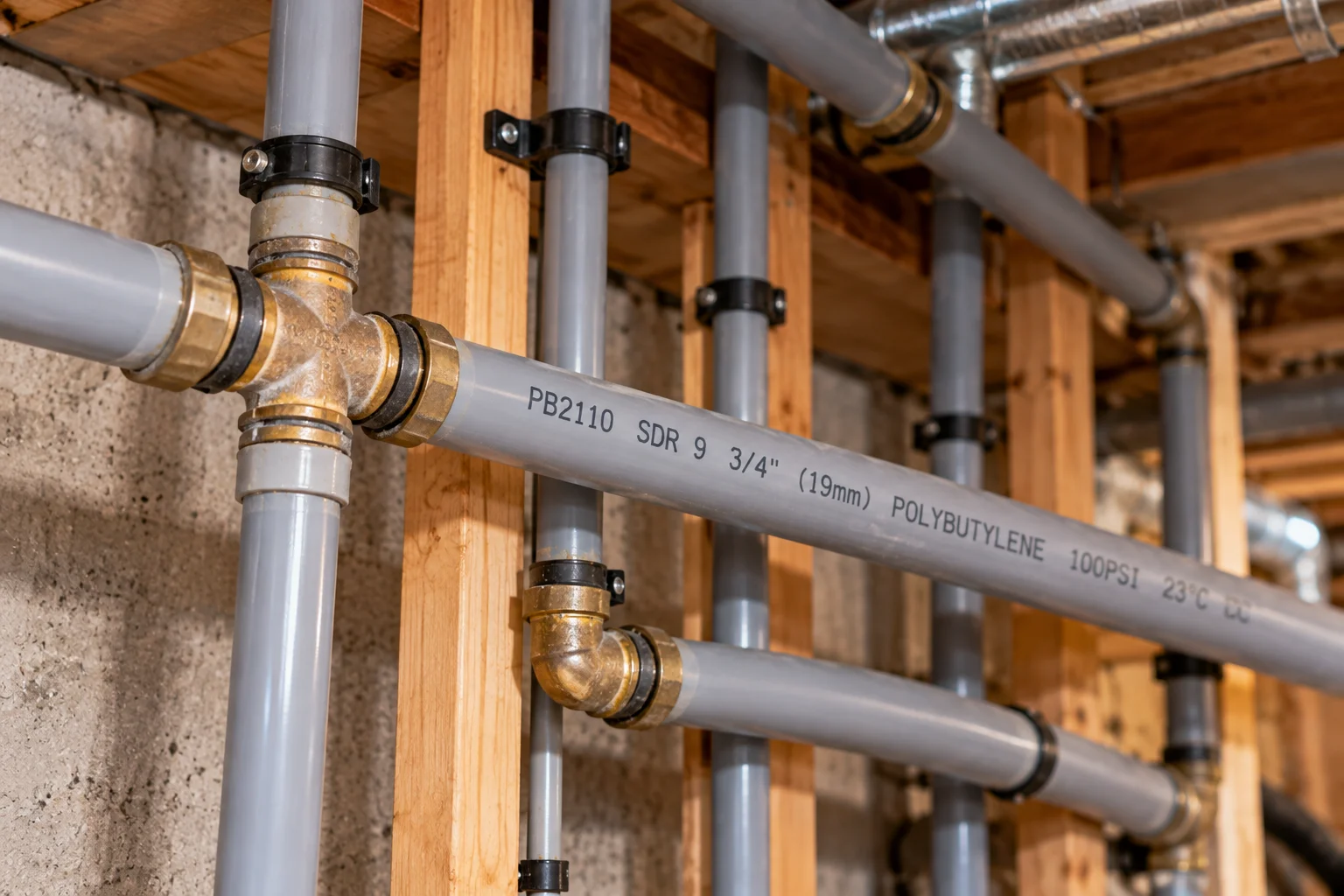
Poly-B is commonly associated with flexible light-grey plastic piping. Depending on lighting, age and surface condition, it may not look exactly the same in every home.
2
Find the printing on the pipe
This is more useful than colour. Rotate your viewing angle or use a flashlight because the printed side may face a joist, wall or other pipe.
3
Confirm that it is water-supply piping
Follow the visible routing. Supply piping will connect into the home’s water-distribution system and feed plumbing fixtures or equipment.
4
Inspect more than one location
One modern-looking pipe beneath a renovated sink does not prove the entire house was repiped. Older material may remain elsewhere.
5
Look at the complete installation
Note fittings, transition points, previous repairs, staining and where the piping disappears into walls or ceilings.
04
What Does PB2110 Mean on a Pipe?
When you’re trying to identify an unknown grey pipe, the printing on the material can be one of your strongest clues. Poly-B piping can carry markings identifying the material as well as information such as pipe size, manufacturer, pressure rating, certification and construction standard.
EXAMPLE OF THE TYPE OF MARKING TO LOOK FOR
PB PB2110 POLYBUTYLENE
Do not worry if every word is not immediately readable. Older printing can be faint, dirty or facing away from you. Check another accessible length of the same piping before giving up.
Most importantly, a material designation is better evidence than deciding that every grey plastic pipe must be Poly-B.
05
Where Should You Look for Poly-B in Your Home?
Start where plumbing is naturally exposed. The goal is to learn about the system without damaging finished walls or ceilings.
Basement or crawlspace
Look where supply piping runs beneath the main living areas or rises toward fixtures above.
Mechanical or utility room
This can provide a useful view of multiple water lines and transitions in one location.
Near the water heater
Follow accessible hot and cold water piping leaving the equipment, while avoiding hot surfaces.
Under sinks
Cabinet plumbing may expose supply lines or transitions to fixture connections.
Laundry area
Exposed supply plumbing near laundry equipment may provide another identification point.
Unfinished ceilings
Open basement ceilings can reveal longer pipe runs and help show whether the material continues through the property.
Don’t perform destructive inspection just to identify it.
If the material cannot be confirmed from safely accessible areas, a plumber can help determine the next appropriate inspection step.
06
Look at the Fittings and Connections, Not Just the Pipe
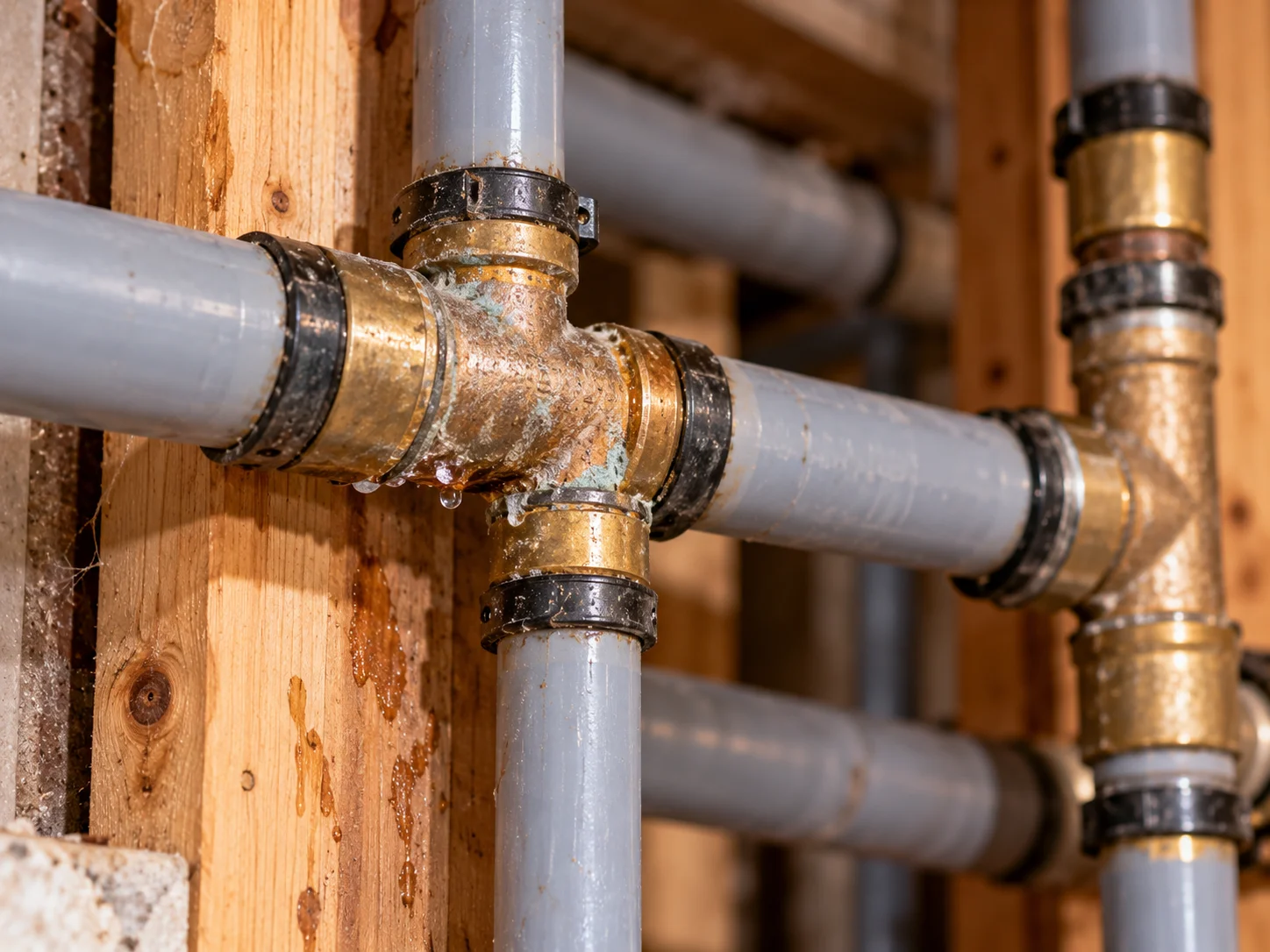
A plumbing system is more than lengths of tubing. Fittings join sections, change direction, branch water lines and transition between different components or materials.
Canadian Poly-B installations did not all use identical fittings. That is another reason not to identify an entire plumbing system from one fitting style.
What homeowners can do is inspect accessible connections for evidence that deserves attention:
- Active droplets or persistent dampness
- Water staining on surrounding materials
- Mineral deposits around connections
- Visible deterioration of nearby components
- Previous patches, transitions or repair work
07
Poly-B vs. PEX vs. Copper: How Are They Different?
Homeowners often confuse different piping materials because a finished plumbing system may contain several of them. The easiest approach is to identify what you actually have rather than trying to match colour alone.
| Material | General appearance | Useful identification clue |
|---|---|---|
| Poly-B | Flexible plastic, commonly light grey | Look for PB/material markings on the pipe |
| PEX | Flexible plastic available in multiple colours | Look for manufacturer/material and standard markings |
| Copper | Rigid metallic tubing | Distinctive metal pipe and soldered/mechanical connections |
PEX is a different material from Poly-B. The fact that both are flexible plastic plumbing products does not make them interchangeable or identical.
08
Why Did Poly-B Plumbing Become a Concern?
Poly-B has received significant attention because failures of pressure-water piping installations were reported in Canada and the United States, eventually contributing to litigation and heightened concern around existing systems.
That history does not mean that every Poly-B pipe fails on a predictable date. Two homes can have different installation details, operating conditions, repair histories and amounts of remaining original piping.
It does mean that discovering Poly-B is useful information about the property. Instead of ignoring it or immediately assuming catastrophe, establish how much is present, look for evidence of existing problems and consider the condition of the overall system.
The useful question isn’t simply “Do I have Poly-B?” It is also: Where is it? How much remains? Are there signs of leakage or previous repair? And what is the sensible long-term plan for this particular home?
09
Warning Signs Worth Paying Attention To
You cannot see the condition of every concealed section of plumbing, but visible symptoms can tell you when further investigation makes sense.
- Water where it should not be Dampness, dripping or unexplained moisture near supply piping deserves investigation.
- Staining around plumbing Water marks on framing, drywall, ceilings or cabinet materials can indicate current or previous leakage.
- Deposits around fittings Build-up around a connection may indicate that moisture has been present.
- Evidence of repeated repairs Multiple transition fittings or repaired sections may help reveal the history of the system.
- A sudden active leak An active plumbing leak should be treated as the immediate problem regardless of the pipe material.
10
Is Finding Poly-B Automatically a Plumbing Emergency?
No. Discovering that your home contains Poly-B is different from discovering an active burst or uncontrolled leak. Identification gives you information that can be used to plan an inspection and make a considered decision about the system.
If water is actively escaping, however, the immediate priority changes. If it is safe to do so, stop the affected water supply, protect people and property from the water and arrange appropriate plumbing assistance.
Active major leak?
Deal with the water first. The question of whether the damaged pipe is Poly-B comes after the immediate leak is controlled.
Emergency Plumbing Help →11
Does Finding Poly-B Mean You Have to Replace It Immediately?
Finding Poly-B does not tell you everything about the plumbing’s present condition, and the fact that the material is no longer used in current construction does not by itself turn an older installation into an emergency.
A more useful decision starts by establishing the extent of the Poly-B, whether there are visible problems, whether portions have already been replaced and whether other practical issues affect the property.
Homeowners may also need to consider renovation plans, accessibility, the history of plumbing repairs and any requirements or limitations raised by their own insurer.
Repairing one section is not the same as repiping the home
A localized repair addresses a particular problem or failed section. A repipe is a broader project intended to replace piping throughout an agreed scope of the water-distribution system.
If a property contains Poly-B in many concealed locations, repairing one accessible piece does not mean the remaining Poly-B has disappeared. That distinction should be clear when comparing repair and replacement options.
12
What Does a Poly-B Plumbing Inspection Look At?
An assessment should do more than confirm that one grey pipe exists. The useful goal is to understand the plumbing system well enough to discuss realistic next steps.
01
Identify
Confirm the piping material from accessible sections and markings where possible.
02
Trace
Determine where the material is visible and how broadly it appears to be used.
03
Inspect
Look at accessible connections, transitions, previous repairs and evidence of leakage.
04
Plan
Discuss whether monitoring, localized work or planned replacement is appropriate for the situation.
Finished homes inevitably contain concealed plumbing. An inspection therefore cannot magically expose every hidden section without opening finishes. The purpose is to combine what can be observed with the layout and history of the property.
13
What Does Poly-B Replacement Actually Involve?
Replacement is not simply a matter of pulling one old pipe out and pushing another through the same hole. The scope depends on how the home is built and where the existing plumbing runs.
Planning the new routes
Before work begins, the replacement system needs a practical route to fixtures and equipment. Access can differ greatly between an unfinished basement and a fully finished multi-level home.
Accessing concealed plumbing
Some piping may be reachable from utility spaces, cabinets or unfinished ceilings. Other sections may require controlled access through finished surfaces.
Installing the replacement water lines
New piping is routed through the agreed project scope and connected to the relevant fixtures, valves and equipment using an appropriate plumbing system.
Testing the completed work
The new installation needs to be checked before the project is treated as complete. The exact inspection and testing requirements depend on the work being performed and applicable local requirements.
Restoration
If finished walls or ceilings require access, restoration is a separate practical part of planning the project. Homeowners should understand what plumbing work and restoration work are included in a quote.
14
What Is Poly-B Replaced With?
Modern repiping does not use Poly-B. The replacement system needs to use plumbing materials suitable for the application and compliant with the requirements that apply to the project.
PEX is one modern flexible plastic piping material commonly encountered in residential plumbing. Copper remains another familiar water-piping material. They are different systems with different fittings, installation methods and project considerations.
In Canada, current plastic pipes intended for potable-water applications are subject to applicable plumbing-code and product-standard requirements. This is one reason a replacement decision should be based on an appropriate complete system, rather than simply choosing a pipe by colour.
There is no need for this guide to declare one material “best” for every home.
Building layout, project scope, applicable requirements and the plumbing design all matter when selecting a replacement system.
15
How Much Does Poly-B Replacement Cost?
There is no responsible single price that applies to every Poly-B home. A small accessible property and a large finished multi-level house can require very different amounts of labour, material and restoration.
Instead of relying on an online price range without knowing the property, understand what actually affects a repiping quote.
- Size and layout of the property Longer routes and more complex layouts generally change the scope of work.
- Number of plumbing fixtures The number and location of bathrooms, kitchens, laundry equipment and other supplied fixtures matters.
- Accessibility Exposed basement piping is different from plumbing hidden behind finished walls and ceilings.
- How much Poly-B remains A partially renovated property may have a different scope from a home with an extensive original system.
- Replacement routing and material The design of the new system affects labour and materials.
- Wall and ceiling restoration Clarify whether restoration is included or handled separately.
A useful estimate therefore begins with the actual property, not a generic internet number.
16
Buying or Selling a Home With Poly-B
Poly-B often becomes a bigger question during a property transaction because buyers, sellers, inspectors, plumbers and insurers may all need different information about the plumbing system.
If you’re considering buying a home with Poly-B
First establish what is actually present. Useful questions include whether Poly-B is throughout the home or only in certain areas, whether sections have previously been replaced, whether there is a known leak history and what a professional assessment says about the accessible system.
It is also sensible to investigate insurance before assuming that one property’s experience will apply to another.
If you own a home with Poly-B and plan to sell
Understanding the system before a transaction gives you better information than waiting until the material is first raised during an inspection or insurance discussion. Keep records of plumbing assessments, repairs and replacement work that has actually been completed.
Questions about legal disclosure obligations belong with the appropriate real-estate or legal professional. A plumbing assessment can document the plumbing condition and work; it does not replace legal advice.
17
Poly-B and Home Insurance
Insurance is one area where homeowners should avoid blanket statements. Insurers can have different underwriting rules, exclusions and information requirements for older plumbing materials.
If you have Poly-B—or are considering purchasing a property that has it—ask the insurer or insurance representative about that specific property and policy. Do not assume that because one homeowner obtained coverage, every insurer will offer the same terms.
If plumbing is replaced, retain invoices and documentation describing the completed work. Your insurer can tell you what documentation it requires.
GOOD PRACTICE
Ask the insurer directly.
A plumber can identify and work on the plumbing system. Your insurer is the appropriate source for the terms, exclusions and underwriting requirements of your policy.
18
You Found Poly-B. What Should You Do Next?
01
Confirm it
Check markings and accessible piping rather than relying only on colour.
02
Document what you can see
Photographs of markings, fittings, accessible runs and previous repairs can be useful.
03
Know your water shutoff
Every homeowner benefits from knowing how and where the main water supply can be shut off safely.
04
Check for visible problems
Look for active leakage, moisture, staining or signs of previous water damage in accessible areas.
05
Determine the extent
Find out whether the material appears throughout the property or whether parts have already been repiped.
06
Get property-specific advice
A plumbing assessment can help turn “I found a grey pipe” into an actual plan for your home.
FAQ
Frequently Asked Questions About Poly-B
Is all grey plumbing pipe Poly-B?
No. Grey colour is a clue, not proof. Look for material markings on accessible sections of the pipe and have the plumbing identified if you’re uncertain.
What does Poly-B usually look like?
It is commonly described as flexible light-grey plastic water-supply piping. Appearance can vary with lighting, age and installation conditions.
What does PB2110 mean?
PB markings on the pipe can help identify polybutylene material. Printed material information is a stronger identification clue than pipe colour by itself.
Where is Poly-B most likely to be visible?
Start in accessible areas such as basements, crawlspaces, mechanical rooms, unfinished ceilings, beneath sinks and around water-supply equipment.
Can my home have both Poly-B and newer plumbing?
Yes. Repairs and renovations can replace only portions of a plumbing system. Finding newer piping in one room does not prove that the entire property was repiped.
Is Poly-B the same as PEX?
No. Polybutylene and cross-linked polyethylene are different piping materials even though both are flexible plastics used in plumbing applications.
Is having Poly-B automatically an emergency?
No. Simply identifying the material is different from an active plumbing failure. An uncontrolled leak or burst pipe is an immediate problem regardless of material.
Can only one damaged section be repaired?
A localized repair and a full repipe solve different problems. Repairing one section addresses that particular area; it does not replace Poly-B that remains elsewhere.
How long does a Poly-B repipe take?
There is no universal timeline. Property size, number of fixtures, accessibility, routing and the amount of finished surface that must be accessed can all affect the project.
Will insurance cover a house with Poly-B?
Insurance requirements vary. Ask the insurer or insurance representative about the specific property and policy rather than assuming all companies treat Poly-B the same way.
Should I open my walls to check for Poly-B?
Not as a first identification step. Begin with safely accessible plumbing. If the material or extent remains uncertain, discuss the appropriate inspection approach with a plumbing professional.
REFERENCE INFORMATION
Sources Used for This Guide
Technical and historical information in this guide was checked against Canadian government and plumbing-code resources, including:
- Government of Alberta — Safety Tips: Polybutylene (Poly-B) Pressure Water Piping.
- National Research Council of Canada — National Plumbing Code of Canada materials.
- Health Canada — guidance concerning residential premise plumbing, potable-water plumbing materials and applicable standards.
- Insurance Bureau of Canada — consumer information relating to older-home plumbing systems and insurance considerations.
This guide is general homeowner information. Building conditions, plumbing requirements and insurance policies can differ by property and situation.
NEED PROPERTY-SPECIFIC HELP?
Not Sure Whether Your Home Has Poly-B?
Proflow can inspect accessible plumbing, help identify what is installed and discuss replacement options when appropriate.

